
Why Are Black Social Work Students in the UK Still Having to Work Twice as Hard? 😤✊🏾
If you've ever walked into a lecture hall and felt like the curriculum was designed for everyone but you, this one's for you.

💝 Did You Know?
Did you know that social work as a formal profession in the UK was largely shaped by Victorian-era frameworks that centred white, middle-class values? Many of the foundational theories still taught today were developed with little to no input from Black or Global Majority scholars. Yet Black communities are disproportionately represented in the very systems social workers navigate, from child protection to mental health services. So the people most affected by social work... are least reflected in how social workers are trained! 💌
🧠 Quick Quiz - Test Your Knowledge!
Here are three quiz questions to test your knowledge after reading the blog... Answers will be at the end, let’s see how many you get right. Remember NO CHEATING... 👀
Question 1: What term describes the dominance of Western European perspectives in academic curricula?
(A) Multiculturalism (B) Eurocentrism (C) Intersectionality (D) Assimilation
Question 2: Which of the following is a key recommendation for supporting Black social work students?
(A) Keeping diversity discussions to Black History Month only (B) Reducing the number of diverse guest lecturers to avoid tokenism (C) Integrating diverse perspectives across ALL modules year-round (D) Focusing solely on crisis-based representations of Black communities
Question 3: What is one major reason Black social work students often suppress their voices in academic settings?
(A) Lack of interest in professional development (B) Fear of being labelled a ‘troublemaker’ and facing professional stigma (C) Preference for individual study over group discussion (D) Limited access to library resources
Now back to the blog... 👇🏾
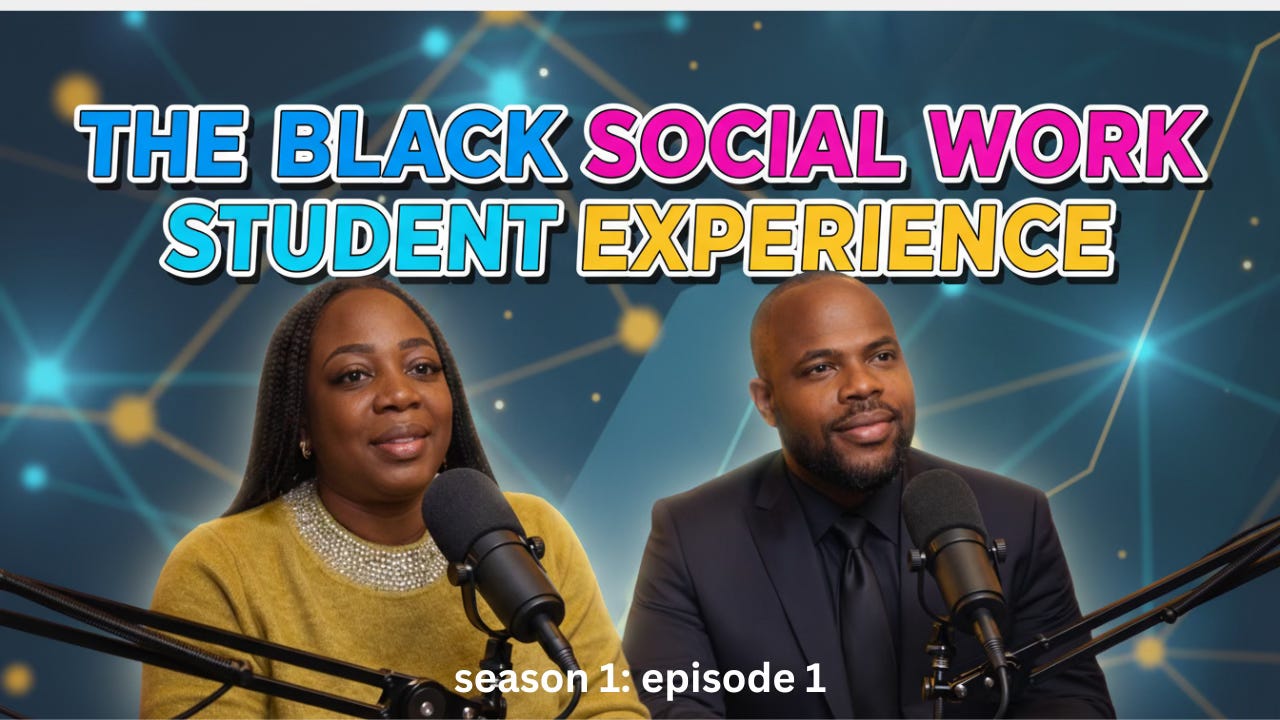
The Real Tea ☕ What Black Social Work Students Are Up Against
Let’s not sugarcoat this. The journey for Black social work students in the UK is not a level playing field. From day one, many students walk into spaces where they immediately feel the weight of having to prove themselves, not just academically, but as people.
We’re talking about being labelled “aggressive” for speaking up. Being called “overly emotional” for bringing lived experience into the room. That’s not feedback. That’s bias.
😤 The “Twice As Hard” Tax
Here’s the tea, working twice as hard to be taken half as seriously is an exhausting reality for so many Black students. And the frustrating part? The problem isn’t the students.
It’s the system that was never built with them in mind. When the curriculum, the reading lists, and the lecture theatres don’t reflect your existence, that silence speaks volumes.
📚 The Curriculum Problem Nobody Wants to Admit
Let’s talk about what’s actually being taught. Right now, Black communities are largely presented in social work education within a crisis context, poverty, family breakdown, child protection. That’s it.
Where’s the rich cultural history? Where are the Black theorists, the Black-led organisations, the Black excellence in practice? Spoiler: it’s been left off the reading list. And that’s not an accident, it’s a structural choice that needs to change.
🌍 What Decolonising the Curriculum Actually Looks Like
This isn’t just about adding one diverse book to the module or hosting a panel during Black History Month (and then going back to normal in November 👀). Real decolonisation means:
Weaving diverse perspectives into every module, all year round
Bringing in guest lecturers from Black-led organisations
Ditching reading lists that treat whiteness as the default lens for everything
It’s about fundamentally rethinking whose knowledge counts in the classroom.
🤝 Support Systems That Actually Support
Curriculum change alone won’t cut it. Black students need robust, independent support structures, not just a diversity officer buried on page 12 of the university website.
We’re talking independent advocacy services so students can raise concerns without fear. We’re talking Black mentorship networks that connect students with practitioners who look like them and get it. Because when you can see yourself in the person at the front of the room? That changes everything.
💥 Truth Bomb
The next generation of social workers, the ones who will walk into families’ homes, make life-changing decisions, support the most vulnerable people in society deserve an education that sees them fully. Not just their potential for crisis, but their culture, their brilliance, their humanity.
Universities: it’s time to stop talking about anti-racism and start doing it.
🎯 Watch the Full Video!
🔍 The specific barriers Black social work students face in UK universities and why they’ve been allowed to persist
💡 Practical, real steps institutions can take RIGHT NOW to decolonise their curricula
🖤 How mentorship and representation are transforming outcomes for the next generation of Black practitioners
Drop a comment, like, and subscribe! Let us know: Have you ever felt unseen or unheard in an academic or professional space and what helped you push through? ☕✨
🧠 Quick Quiz: Answers
Answer to Question 1 Answer: B) Eurocentrism The dominance of Western European perspectives in academic curricula is known as Eurocentrism and it’s a central challenge in social work education today.
Answer to Question 2 Answer: C) Integrating diverse perspectives across ALL modules year-round Diversity can’t be a once-a-year event. Meaningful inclusion means embedding different cultural frameworks and voices throughout the entire curriculum.
Answer to Question 3 Answer: B) Fear of being labelled a ‘troublemaker’ and facing professional stigma Many Black students choose to endure subtle racism rather than risk having their professional reputation damaged, a painful choice no student should ever have to make.